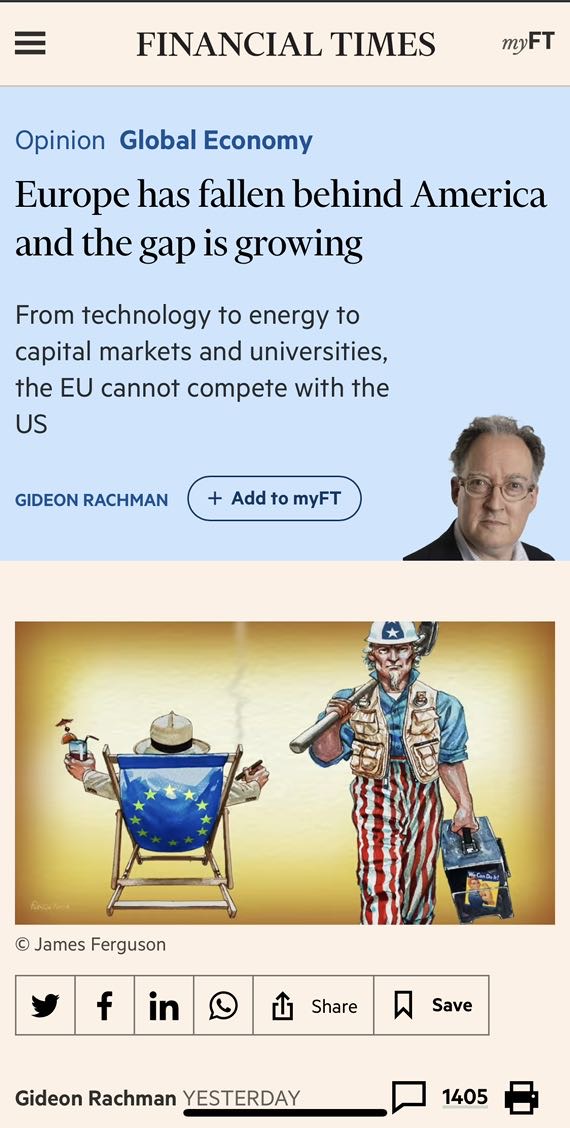
Article in the FT this weekend, titled: "Europe has fallen behind America, and the gap is growing". This is a topic that has been furiously discussed in my industry over the last decade, and is now becoming a well accepted fact.
A quote:
In 2008, the EU and the US economies were roughly the same size. But since the global financial crisis, their economic fortunes have dramatically diverged. As Jeremy Shapiro and Jana Puglierin of the European Council on Foreign Relations point out: "In 2008 the EU's economy was somewhat larger than America's: $16.2tn versus $14.7tn. By 2022, the US economy had grown to $25tn, whereas the EU and the UK together had only reached $19.8tn. America's economy is now nearly one-third bigger. It is more than 50 per cent larger than the EU without the UK."Smart people in my industry have come up with a myriad potential reasons for this:
1) The atomization of Europe
2) Burdensome regulatory environment
3) Rigid labor markets
4) Access to cheap energy
5) Ineffective monetary policy
6) and so on, and so forth...
However, I have my own view on this, which is very simple. I'll admit I have not done much research to confirm this. So here it is:
1) In 2004 the EU went through a historic expansion. The so called "A10" countries were admitted. These included: Cyprus, the Czech Republic, Estonia, Hungary, Latvia, Lithuania, Malta, Poland, Slovakia and Slovenia.
2) The dynamic economies of Western Europe were suddenly saddled with a huge task of getting the poor East to catch up with them.
3) Huge transfers of capital began to occur, in a West-East direction.
4) Money taken out of effective economies, was squandered on projects in countries with far lower productivity, and much higher corruption.
5) Money does not grow on trees.
6) How fast would the US economy grow if in 2004, Mexico was annexed?
1F3C17C9E76D43DC8.jpeg